
Dental Implants in Buenos Aires
THE SOLUTION TO THE LACK OF TEETH
If there are gaps in your smile where your permanent teeth used to be, you may realize that more is missing from your life than just teeth. You may also give up good nutrition and even social activities.
It doesn’t have to be that way, though. Dental implants are an excellent alternative to fill the empty gaps left by tooth loss.
We are dental implant specialists. At our office we have a TC Scan for accuracy and microsurgery guided surgery. For the patient is less time of surgery and more confort.
We also use short implant for safe surgeries.
Lots of people find that dental implants are more comfortable, efficient, and safe than conventional dentures or dental bridges.
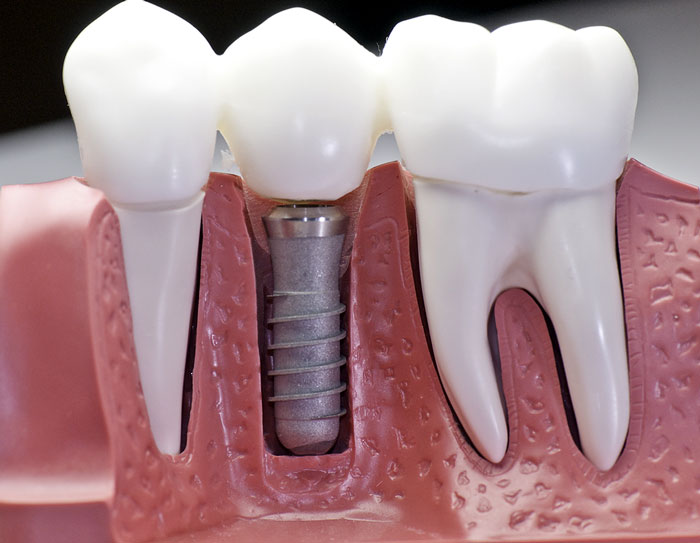
Dental implants are artificial tooth roots made of biocompatible titanium or zirconium placed into the jawbone to replace a single missing tooth without involving adjacent teeth. After some months (the time varies with each case) an implant-supported prosthesis is attached to the implant.
Unlike the old removable prostheses, this new alternative affords better function and aesthetics, providing greater stability while improving chewing efficiency and phonetics.
Dental Implants provide patients with greater comfort, enhancing their quality of life.


CALL NOW +54 (011) 4821 0821
FAQ about Dental Implants
What are dental implants?
Finally, a realistic-looking artificial porcelain crown is attached to the abutment, creating a three-piece device that restores your smile. Depending on your situation, you may have one or many teeth replaced with dental implants.
Are dental implants a possible treatment for you?
Dental implants may be a possible solution if you:
• Have lost one or more teeth. You should know that it is not a good idea to allow much time to pass before replacing a lost tooth, since the bone’s volume tends to diminish as time goes by.
• Have healthy oral tissue.
• Want to protect adjacent teeth (it is the best alternative to bridgeworks).
• Are unwilling or unable to wear conventional dentures, because they are loose and unstable.
• Your jawbone has reached its full growth.
• Have sufficiently strong jawbone, or if it’s possible to have a bone augmentation procedure.
• Don’t have health conditions that will impair bone healing.
• Want to smile again self-confidently. Some people with conventional prosthesis are afraid their false teeth move or come off when they speak or smile.
• Want to be able to chew and bite firmly again, digest food much better and enjoy your meals.
What happens during the preliminary stage?
To start, you have to fill a health history form because we need to know about any medical condition you may have and any medication you take, including prescriptions, over-the-counter medications or supplements. For example, if you have a heart condition or vascular or orthopedic implants, we may prescribe antibiotics before implant placement to help prevent infection.
The next step is a thorough dental exam. This may include dental X-rays (panoramic, periapical, computed tomography, etc) and if necessary, making models of your mouth and a computerized three-dimensional reconstruction of your jawbones.
A treatment plan is tailored to your particular situation. This plan takes into account such factors as the number of teeth being replaced and the condition of your jawbone. If the number of implants necessary is less than 10, your will have to stay in Buenos Aires for at least 7 days. If the number is higher than 10,a few more days are advisable.
How is the dental implant placed? (First stage)
In general terms, the dental implant cylinder is first implanted in your jawbone, and then you must undergo a healing period. After that, the abutment is placed (second stage), followed by a shorter healing period.
Finally, you get your new artificial tooth, sometimes also called an implant prosthesis or crown. Nowadays it is possible in selected patients to accelerate the healing time. In some cases we can perform an immediate loading technique, which means we place a fixed prosthesis the same day we place dental implants. However, the general protocol states you should wait 3 months in the lower jaw and 4 months in the upper jaw.
Some people may require bone augmentation before the initial dental implant surgery, which lengthens the entire process.
In some cases, it is necessary to remove a futureless tooth and we attach the implant in the hole that the root of the tooth leaves behind when it is removed.
After implant placement you will still have a gap where your tooth is missing. Usually, a temporary denture can be placed.
Once the dental implant is placed in your jawbone, osseointegration begins. During this process, the jawbone fuses with the surface of the dental implant. This process usually takes three to six months.
This is an important step because it helps provide a very solid base for your new artificial tooth.
Does it hurt to have dental implants placed?
The level of discomfort changes from patient to patient, but most of them do not have significant problems. Dental implants procedure is generally not a painful process.
In some cases a micro-traumatic surgery can be performed. Whenever it’s possible we perform this microsurgery technique and our patients have almost no discomfort at all. With this new technique, blades and stitches are often unnecessary.
What happens after dental implant positioning?
After the procedure you may experience some of the typical discomforts associated with any type of dental surgery. These may include:
• Bruising of your skin and gums
• Moderate swelling of your gums and face
• Mild pain at the implant site
• Minor bleeding
Occasionally after the implant placement it is recommended that the patient go without their prosthesis for a short period of time.
You may also need to eat soft foods for five to seven days.
If the stitches aren’t self-dissolving, we will remove them in about 7 to 10 days.
What happens at the second stage?
Three to six months later, osseointegration is complete, and you need to place the abutment to which the crown will eventually be attached. Once the abutment is placed, the gum tissue is then closed around, but not over, the abutment.
In some cases, the abutment is attached to the dental implant cylinder at the same time that the cylinder is implanted. That means you won’t need an extra step. However, because the abutment juts past the gum line, it’s visible when you open your mouth – and it may be that way for six months or so.
After the abutment is placed, your gums must heal for one week before the artificial tooth can be attached.
Once your gums have healed, you will have impressions made of your mouth and remaining teeth. These impressions are used to make the crown – your realistic-looking artificial tooth, or prosthesis.
We can choose from two main types of artificial teeth. They are:
• A removable implant prosthesis. This type is similar to a conventional removable denture. It’s mounted on a metal frame that’s attached to the implant abutment, and it snaps securely into place. It can be easily removed for daily cleaning. It’s often a good choice when several teeth in the lower jaw are replaced, being more secure than a traditional denture.
• A fixed implant prosthesis. In this type, an artificial tooth is permanently screwed or cemented onto an individual implant abutment. You can’t remove the tooth for cleaning or during sleep. Each crown is attached to its own dental implant. The implants and the prosthesis will become a part of your mouth; and they will have the same stiffness and function of your own healthy teeth.
When bone augmentation is required?
The new bone will grow, but it may take six to nine months to grow enough to support a dental implant. In some cases, you may need only a small bone augmentation that can be done at the same time as the implant surgery. It depends in the condition of your jawbone.
How long dental implants last?
If used correctly, and if the hygiene is good, implants have proven a durability of more than 20 years.
What happens when a dental implant doesn't work?
Making your dental implant a success
Certainly most dental implants are successful. However, you can help your dental work (and also remaining natural teeth) last longer if you:
• Perform excellent oral hygiene. Like your natural teeth, implants, artificial teeth and gum tissue must be kept clean, free from bacteria. Specially designed brushes or floss, such as an inter-dental brush that slides between teeth, can help clean the spaces around teeth, gums and metal abutments. Special devices, like electronic mouth rinses, also help improve hygiene. There can be an infection or an inflammatory condition in the soft tissue if hygiene is not proper.
• Avoid smoking. Dental implants have lower success rates in smokers than in non-smokers.
• See your dentist regularly. Schedule dental checkups every six to 12 months to ensure the health and proper function of your implants.
• Avoid harmful habits. Don’t chew hard items, such as ice and hard candy, which can break your crowns, or your natural teeth. Avoid tooth-staining tobacco and caffeine products.
• Get treatment if you grind and clench your teeth. If not, there can be problems with the connection between the implant and the crown.
